Karate · Japan, 1930s
Shotokan Karate
松濤館
Shotokan is the most widely practised style of karate in the world, developed by Gichin Funakoshi (1868–1957), the Okinawan schoolteacher credited with bringing karate to mainland Japan. "Shoto" ("pine waves") was Funakoshi's pen name, and "kan" means hall or house — literally, "the house of Shoto." His students later founded the Japan Karate Association (JKA), which spread the style globally.
Shotokan is known for long, strong stances, powerful linear technique, and a training method built on three pillars: kihon (basics), kata (forms), and kumite (sparring). It rewards precision, commitment, and honest, repeated effort.
My own Shotokan background runs through JKA-lineage traditional karate, including time affiliated with the World Traditional Karate Organization (WTKO), founded in 2000 by John Mullin and Richard Amos to preserve traditional Shotokan principles.
In our dojo
Shotokan is the foundation of how I teach — the structure, discipline, and belt path I came up through.
Karate · Okinawa, 1952
Gōjū-ryū Meibukan
剛柔流 明武舘
Gōjū-ryū — Japanese for "hard-soft style" — is one of the great traditional Okinawan systems, founded by Chojun Miyagi in the early 20th century from the Naha-te lineage of Kanryo Higaonna. Its name captures its essence: hard, linear force (gō) balanced with soft, circular movement (jū), rooted in breathing and body conditioning.
Meibukan ("house of the pure-minded warrior") is the branch of Gōjū-ryū created by Meitoku Yagi (1912–2003), one of Miyagi's most senior students — the man entrusted with his teacher's gi and belt, and later named a Living National Treasure of Japan. Meibukan is known for emphasising self-defence and character over sport, famously teaching "not how to win, but how not to lose."
In our dojo
Gōjū-ryū shaped how I teach breathing, body conditioning, and close-range control — the "soft" that balances Shotokan's "hard."
Karate · Kung Fu roots
Kempo Karate & Temple Kung Fu
Kempo (or Kenpo) means "fist law" — a family of arts blending Chinese kung fu with Japanese and Okinawan karate. Kempo is known for fast, flowing hand combinations and adaptability, bridging the circular movement of kung fu with the directness of karate.
I trained Kempo Karate through Temple Kung Fu under Grandmaster Simon, which added a different rhythm and a more improvisational approach to my striking.
In our dojo
Kempo sharpened the reflex and flow side of my teaching — reacting fast and stringing techniques together under pressure.
Weapons · Okinawa, 20th c.
Matayoshi Kobudō
又吉古武道
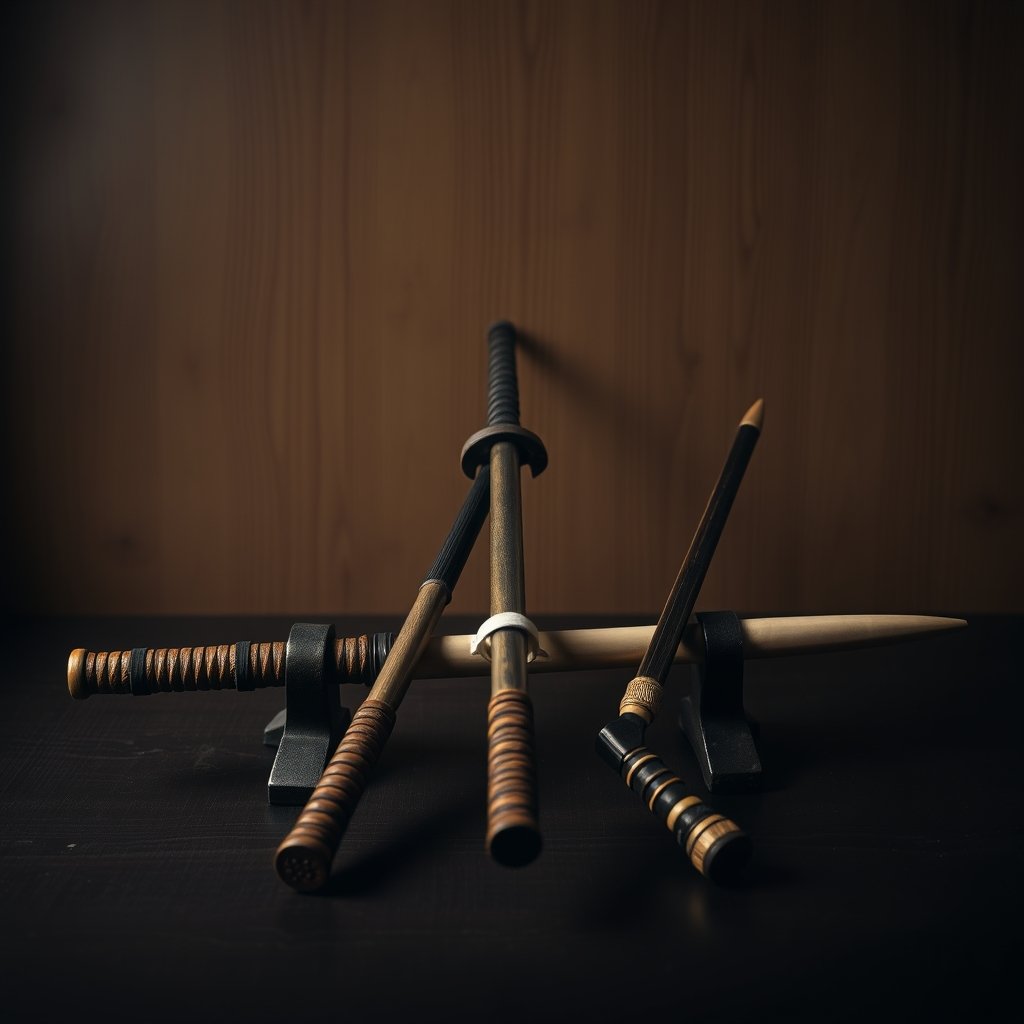
Kobudō — "the way of ancient weapons" — is the Okinawan art of traditional weaponry, developed from farming and fishing tools during centuries of weapons bans on the island. Matayoshi Kobudō is one of its major lineages, developed by Matayoshi Shinko (who once demonstrated for the Japanese emperor alongside karate masters Miyagi and Funakoshi) and carried on by his son Matayoshi Shinpo (1921–1997) from the Kodokan dojo in Naha.
The system covers a wide range of weapons — the bō (staff), sai, tonfa, nunchaku, kama, eku, and more — each with its own kata and applications. Training weapons transforms your understanding of distance, timing, and body mechanics, even in empty-hand technique.
In our dojo
Kobudō sharpens distance and timing — and it's a genuinely fun way to deepen your karate. Ask us about weapons training.
Kicking art · Korea, 20th c.
Taekwondo
跆拳道
Taekwondo — "the way of the foot and fist" — is Korea's national martial art and one of the most practised in the world, an Olympic sport since 2000. Developed in the mid-20th century from Korean traditions and influences including karate, it's famous for its fast, powerful, and high kicking, agility, and dynamic footwork.
Taekwondo has been part of my own martial arts journey, and it also has a home at our dojo today: a dedicated Taekwondo program trains out of our building as its own separate class. If Taekwondo is what you're after, ask us and we'll point you their way.
In our dojo
Taekwondo's kicking, hip mobility, and footwork inform how I think about range — and a Taekwondo program shares our mat as a separate class.
Full-contact · modern
Kickboxing
Kickboxing is a modern full-contact striking sport combining punches and kicks, developed from karate, Muay Thai, and Western boxing in the 1960s and 70s. Where traditional karate emphasises form and lineage, kickboxing is built around live, resisting practice — pad work, conditioning, and controlled sparring.
For me, it's the pressure-test: the place where technique meets a moving, reacting opponent and gets honest fast.
In our dojo
Kickboxing is where the strength and reflex work pays off — conditioning and live reaction that make the rest real.